
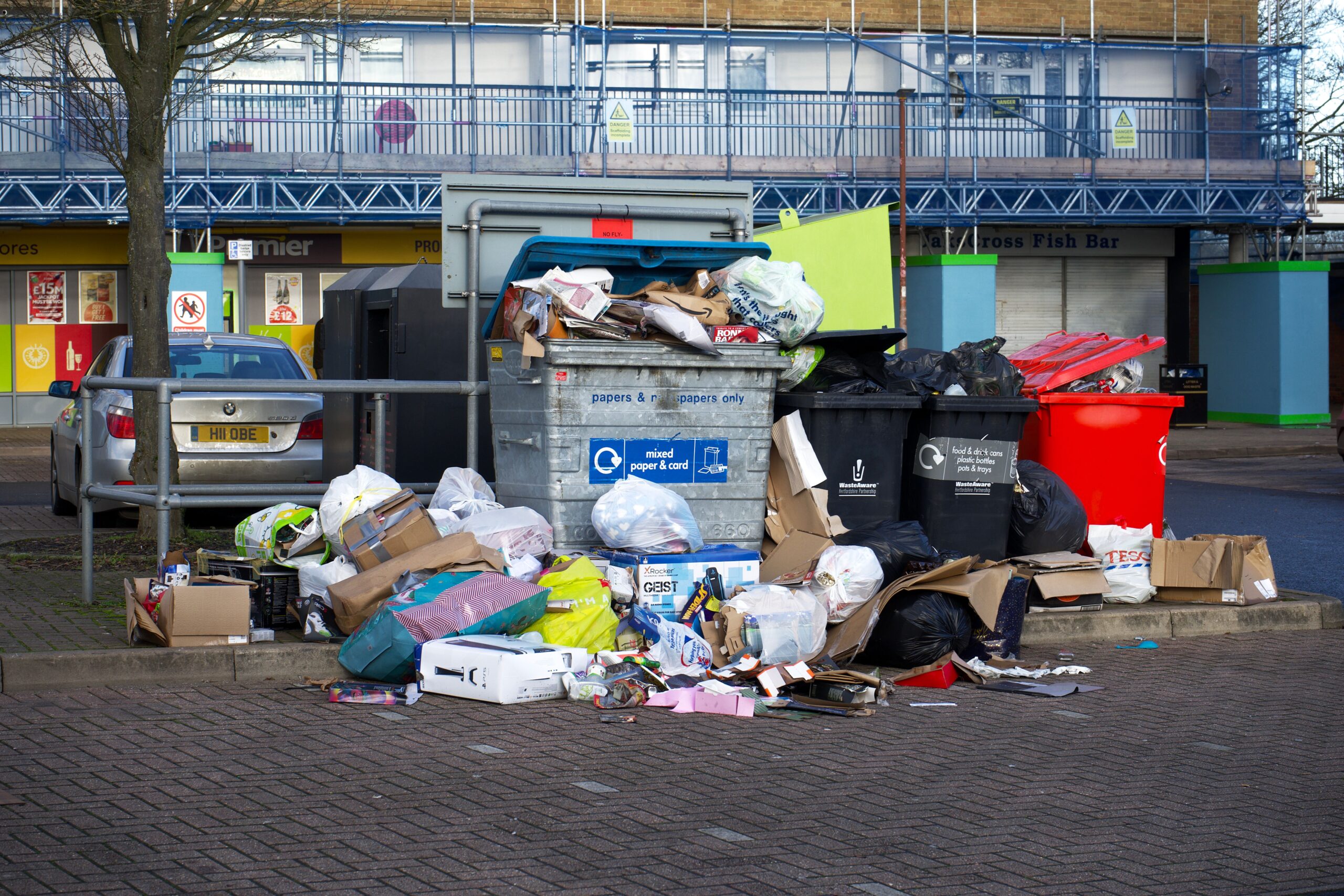
Waste management in Luxembourg is organized at the level of communes. Cost associated with collection and processing of waste is paid by residents and it largely can differ from one commune to another. In this article, we take a look at how much a resident of Luxembourg pay for their trash to be picked up versus how the same system functions in two other major economies in Europe; i.e. Germany and France. We also take a closer look at the fees associated with EPR in these three countries in practice.
How much does a household actually pay for waste in Luxembourg?
Let’s have a look at Differdange, the third largest town in Luxembourg with an estimated of over 31,000 inhabitants in 2026 and a transparent fee system for waste management.
Each household pays a fixed waste connection charge of €186 per year (€46.50 per quarter). On top of this, households pay each time their grey residual-waste bin is emptied: €3 for an 80-litre bin, €4.50 for 120 litres and €9 for 240 litres.
For example, a household using a 120-litre grey bin twice per month would pay €294 which also supports the broader municipal waste system from the fixed annual charge, while several separately collected waste streams can be emptied without an additional collection charge:
- paper and cardboard: blue bin, emptied every four weeks;
- glass: brown bin, emptied every four weeks;
- organic waste: green bin, collected weekly for much of the year and every two weeks during winter;
- plastic, metal and beverage-carton packaging: Valorlux blue bags, collected every two weeks.
There are, however, some one-off container costs. A 120-litre paper bin costs €30, for example, and certain glass bins also cost €30, while the standard organic bin is supplied free.
How is the EPR fees calculated in Luxembourg and who pays for it?
Valorlux is Luxembourg’s approved producer-responsibility organization for household packaging. Companies that place packaged goods on the Luxembourg market pay packaging-EPR contributions to Valorlux. Valorlux then uses these contributions to organize or finance the collection, sorting and recycling of relevant packaging waste.
For households, the most visible part for residents of the country is the free blue-bag system distributed by the communes. The Valorlux blue bag accepts plastic packaging, metal packaging, beverage cartons. It does not accept ordinary paper/cardboard, glass, black plastic, many multi-layer packages or Styrofoam.
While the blue-bag is free at the point of collection for the household. Its cost is financed through the producer-responsibility system, which is ultimately reflected to some extent in the prices consumers pay for packaged products.
Valorlux’s simplified 2026 tariff gives a useful illustration: the category for dispatch/mail-order packaging is charged at about €0.021 per packaging unit. The producer pays that contribution, although economically it may ultimately be incorporated into the price paid by the purchaser.
Valorlux financially contributes to the paper, cardboard and glass collection systems, because these packaging materials also fall under producer responsibility.
How does Luxembourg compare with France?
France also has longstanding packaging EPR, while municipal waste services are commonly financed through the Taxe d’enlèvement des ordures ménagères (TEOM).
The important difference is that the TEOM is generally linked to the property-tax value of the dwelling, rather than directly to how many times the household puts out its bin.
In Paris, for example, the TEOM is charged through the property-tax system. The owner legally pays it but may recover it from the tenant as a rental charge. Paris states that the tax is payable regardless of the actual amount of waste generated.
Across France, TEOM generated approximately €9.2 billion in 2025, illustrating the scale of household/local financing that already exists alongside EPR contributions from producers.
Consumers effectively support waste management through:
- municipal waste taxation such as TEOM;
- EPR costs incorporated into packaged goods;
- potentially additional local or specific waste charges depending on the municipality.
How about EPR in France? In France, the EPR obligation for household packaging has existed since 1992. A company that places household packaging on the French market generally fulfils its obligation by joining an approved eco-organization, most commonly Citeo. By joining Citeo, the producer transfers its operational EPR responsibility to the organization and pays an eco-contribution. Citeo then uses those contributions to finance collection, sorting, recycling, reuse and related system costs.
The contribution is not a single flat national “tax per package.” For household packaging, Citeo calculates contributions according to the number of consumer sales units placed on the French market, together with the packaging characteristics and the declaration method used. Small producers can use simplified declaration schemes, while larger producers report in greater detail. Citeo publishes annual tariff schedules.
Consumers do not normally see a separate “Citeo fee” at checkout. The producer treats it as a business cost, which can be incorporated into the selling price.
How about Germany?
Germany likewise combines municipal household waste charges with one of Europe’s oldest packaging-EPR systems.
Municipalities generally charge households for residual waste and often organic waste, with prices depending on the municipality, bin size and collection frequency. Packaging made of plastic, metal and composite materials is separately collected through the yellow bin/yellow bag system, financed through producer-responsibility arrangements rather than a direct household collection charge.
Berlin illustrates this split particularly well. Households separately sort:
- residual waste;
- organic waste;
- paper/cardboard;
- glass;
- plastics/metals/composite packaging through the Wertstoff system.
Berlin’s municipal system explicitly notes that separating organic waste can reduce residual-waste charges; households able to reduce the frequency of residual-bin collection can save up to about 12%.
How does the EPR system for household packaged goods work in Germany?
A producer placing packaged goods on the German market must first register with the Zentrale Stelle Verpackungsregister (ZSVR) through the LUCID Packaging Register.
For packaging that typically becomes waste in private households, however, registration alone is not enough. The producer must also conclude a contract with one of Germany’s licensed dual-system operators and pay that system to organize the recovery and recycling of its packaging.
Unlike France, there is not one dominant national eco-organization setting a single public tariff. Germany has competing system operators, so the participation fee is essentially a commercial price agreed with the selected system. Material, weight and recyclability affect the cost. The rules increasingly require fees to reflect how recyclable the packaging is.
The household then disposes of relevant packaging through systems such as the yellow bag/yellow bin, without paying a separate collection fee for that packaging at the point of disposal. The system operators are financed through the producer contributions embedded upstream.
Final thought
European households already finance municipal waste systems directly through taxes or waste fees. At the same time, consumers indirectly finance EPR through the prices of packaged goods.
A key policy question for consumers is whether EPR financing genuinely displaces part of the cost previously borne by households, or whether it simply adds another financing layer without a corresponding reduction elsewhere. This leads to a more rhetorical question: in the examples discussed in this article, can we really call the system Extended Producer Responsibility, or does it sometimes function in practice more like an Extended Consumer Cost of Packaged Goods?
Many countries have recently established EPR systems or are currently working towards them. Looking closely at how other countries have designed and implemented their models can therefore be immensely useful—not to copy one system, but to understand how the same concept can operate very differently in practice, who ultimately bears the cost, and where that money is directed.
It is important to differentiate what EPR legally means, and what happens operationally to the waste after the producer/PRO pays for or organizes its management. Our next insight will take a closer look at this.
Have you read our previous insight?
Extended Producer Responsibility (EPR) – An Effective Waste Policy?