
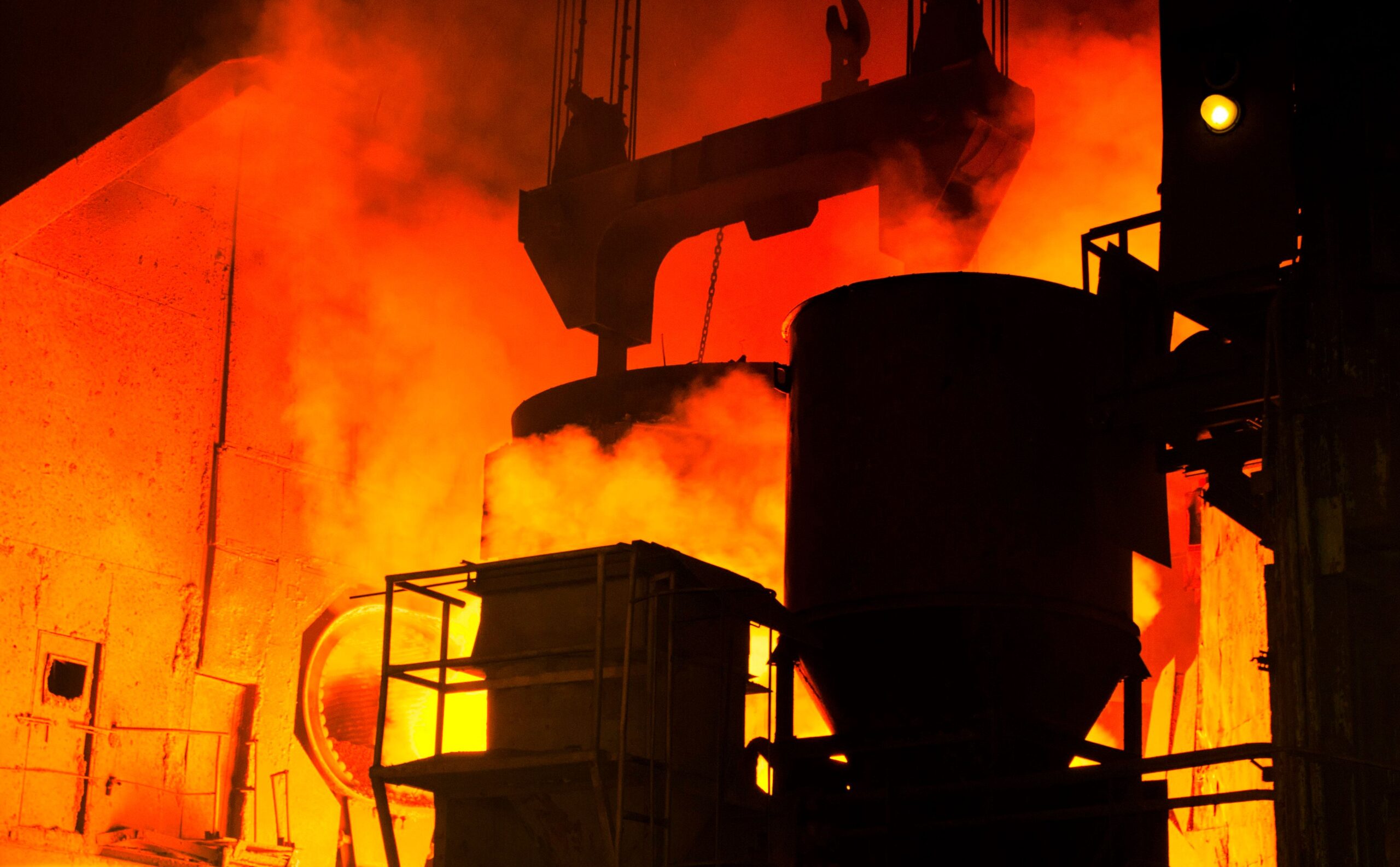
Visiting Differdange, a town in southern Luxembourg with a population of over 30,000, one wonders what it means to live beside an operating steelworks. Differdange is today Luxembourg’s third-largest city, and home to a giant ArcelorMittal steel production site in the center of the city.
Steel making ranks amongst the most polluting industries because it combines several impacts at once: very high energy and CO₂ emissions, particulate matter, NOx/SOx depending on the process, heavy metals, slag and dust residues, significant material throughput, and water use/wastewater issues. UNEP has previously placed iron, steel and ferroalloy manufacturing among the highest-impact sectors globally when environmental damage and health costs are considered together.
For many people outside Luxembourg, the country is associated primarily with banking, investment funds and insurance. Yet Luxembourg built much of its modern prosperity long before financial services came to dominate its economy.
The discovery of iron ore in the south in the 1840s, the expansion of the railway network and access to larger European markets transformed what had largely been an agricultural economy into an industrial power. By the eve of the First World War, Luxembourg ranked among the six largest steel-producing countries in the world. As late as 1970, steel still accounted for 27.9% of the country’s total added value. Today, by contrast, around 88% of Luxembourg’s wealth is generated by services. (The Steel Industry and Luxembourg)
The transformation was particularly dramatic in southern Luxembourg. The Minett, the industrial region in southern Luxembourg, was a region of mines, furnaces, railways and rapidly expanding industrial towns. Workers arrived from Luxembourg and abroad, while housing and infrastructure struggled to keep pace. University of Luxembourg research describes the region between roughly 1870 and 1970 as one characterized not only by economic and population growth, but also by environmental pollution and precarious housing and living conditions.
When pollution was part of everyday life
Pollution in Differdange was not an abstract environmental issue.
Historical research uncovered government measurements made around the Differdange steel complex in 1956–1957. Dust deposition reached about 140 grams per square meter per month close to the center of pollution, declining to around 40 g/m²/month two kilometers away. Near the plant, as much as 75% of the measured dust content consisted of iron compounds. The samples also contained silica and other industrial particles.
To put those figures into context, this was material physically falling out of the atmosphere onto houses, streets, gardens and people.
A 1950 letter published in the Luxemburger Wort, later documented by University of Luxembourg researchers, described Differdange as a town of black roofs, streets and gardens, with dust settling on windows, furniture, laundry and even beds. The complaint also described irritation to the eyes and lungs and concern about vegetables grown in local gardens.
Historical research shows that air pollution in the Minett was already being publicly discussed in the early twentieth century, decades before environmental regulation became a major political issue in Europe.
The factory is there and so is the pollution!
The Differdange site produces some of the world’s largest structural beams, used in high-rise buildings and major engineering projects. Luxembourg steel has been used in structures ranging from the One World Trade Center to the Burj Khalifa. However, the technology bears little resemblance to the blast-furnace steelmaking of the industrial boom years.
The site now operates an electric arc furnace, ladle furnace, vacuum degasser and continuous caster, alongside its Grey rolling mill. Scrap steel is melted using electric arcs at temperatures exceeding 1,600°C before being refined, cast and rolled into large structural sections. Electric-arc production based largely on recycled steel avoids many of the emissions associated with producing primary steel from iron ore and coke in traditional blast furnaces.
Furnace gases are extracted and filtered, while modern systems capture particles before exhaust gases are released. Government monitoring confirms that concentrations of dioxins, furans and many heavy metals have fallen strongly since 1996 around industrial sites including Differdange, Esch-sur-Alzette and Schifflange. Authorities attribute this improvement partly to industrial modernization, better emission control and reductions in traditional steelmaking activity.
There is little doubt that today’s Differdange is dramatically cleaner than the industrial town described in the 1950s. Yet, cleaner does not mean that pollution does not exist.
The pollution that remains
Even with an electric furnace and modern filtration, steel production continues to generate dust, gases, slag, wastewater and other industrial residues.
ArcelorMittal itself acknowledges that diffuse dust emissions remain an issue at Differdange. In 2024 the company announced a €17.6 million project designed to reduce these emissions by as much as 80%, using industrial extraction hoods positioned close to the most important emission sources. The system was scheduled to become operational in 2026.
By early 2026, the investment had reportedly expanded to around €23 million, with a system capable of extracting approximately 1.2 million cubic meters of air per hour.
ArcelorMittal has also relocated its liquid black-slag pits, which were previously situated closer to residential areas, into an enclosed hall nearer the furnace. The company explicitly describes the project as a measure to reduce dust and noise affecting the neighborhood.
Today’s residents of Differdange describe dust accumulating on cars, terraces, windows and outdoor furniture. Moreover, residents notice occasional industrial odors that are distinct from the sulfur smell previously investigated by Luxembourg’s Environment Administration. Potential sources may include fumes from scrap melting and post-combustion, secondary metallurgy, natural-gas combustion and the handling of hot slag.
The question is no longer whether Differdange experiences the extreme industrial pollution of the twentieth century. The more useful question is what environmental footprint remains when heavy industry operates in the middle of a modern European city using some of the best available technologies?
That question extends beyond air pollution.
Steel production requires substantial quantities of water. It creates industrial wastewater that must be treated. More than a century of industrial activity can also leave contaminants in soil long after particular furnaces or production lines have disappeared.
Those questions deserve their own examination. That is why this is a series of article through which we will look at air, water and soil pollution caused by steel industry in Differdange and try to answer questions such as: how much a modern steelworks needs, where Differdange’s water comes from, how much is reused, how industrial wastewater is treated and what eventually returns to the environment, and how steelworks impacts soil’s health.
Have you read our previous insight?
Extended Producer Responsibility in Europe: Is the Producer Really Responsible?