
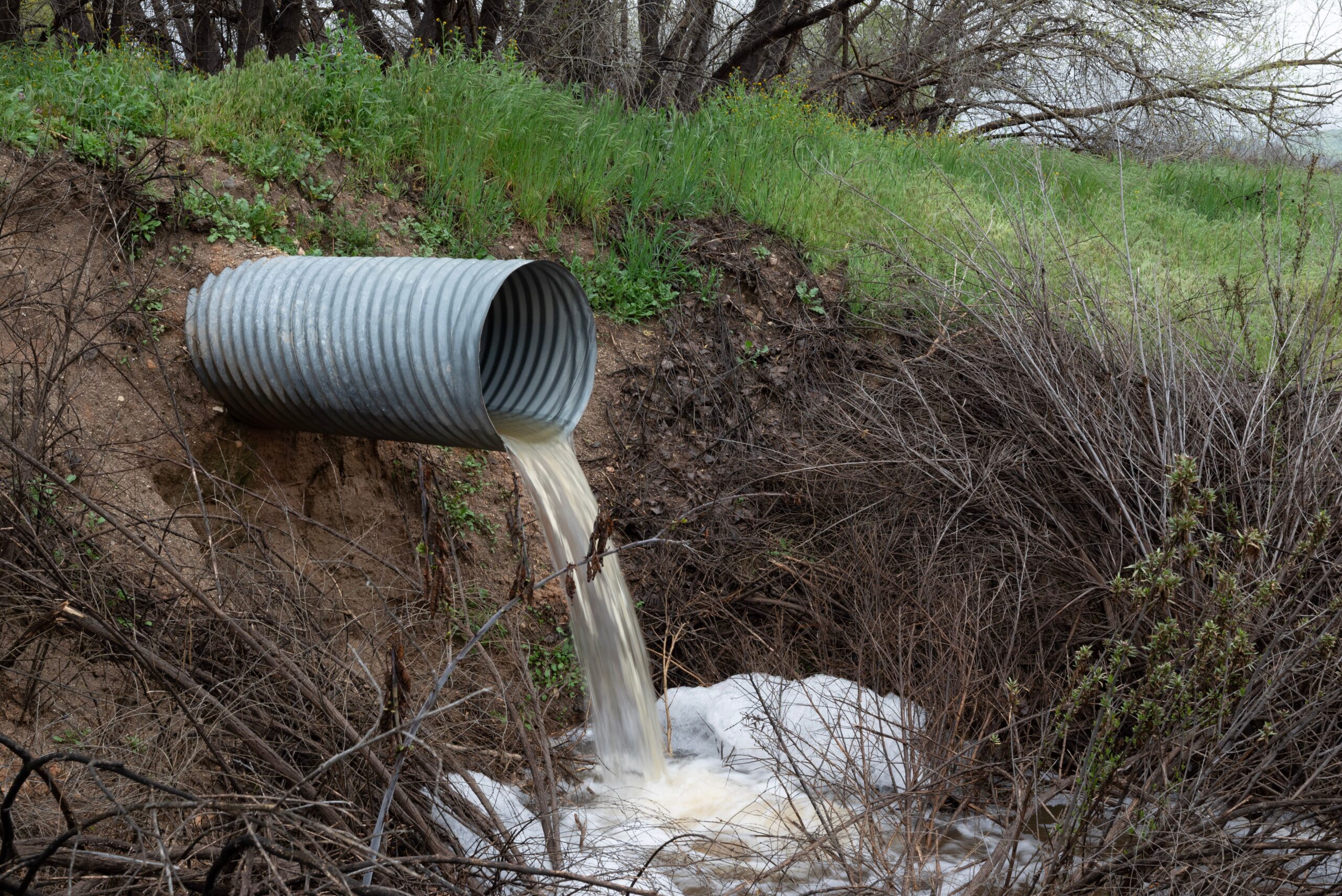
Steel-making uses considerable amount of freshwater, as an essential part of cooling equipment, removing oxide scale from hot steel during rolling, carrying particles away from machinery, gas cleaning, washing and other process operations.
Steel-making belongs to the group of industrial activities with the highest potential impact on freshwater. CDP’s Water Watch, which ranks more than 200 industrial activities according to both water use and pollution potential, classifies metal processing and smelting in its highest “Critical” water-impact band. Other highly water-intensive sectors include chemicals, pulp and paper, mining, textiles, energy, and food and beverage production.
In Differdange, the history of steel production is closely tied to the Chiers, the small river that rises near Oberkorn and flows through the town before continuing toward Belgium and France.
When the river was part of the wastewater system
Before modern sewer infrastructure, domestic wastewater from Differdange and surrounding areas was discharged directly into the Chiers. ARBED then used part of this polluted flow as industrial water. According to le Syndicat Intercommunal pour l’Assainissement du bassin de la CHiers (SIACH), the wastewater carried by the Chiers was allowed to settle in basins before being reused by the steelworks, particularly for cooling.
From the 1970s onward, new underground wastewater collectors progressively separated sewage from the river. Instead of entering the Chiers directly, wastewater was transported to a mechanical-biological treatment plant built on ARBED land.
The old Differdange treatment plant was eventually unable to meet newer requirements, particularly for nitrogen and phosphorus removal, and was closed in 2014. Municipal wastewater is now transported to the larger Pétange treatment plant, where it is treated before the effluent is discharged back into the Chiers.
How water is used today
Modern steel production in Differdange is very different from the old integrated steelworks. The site now uses an electric arc furnace and rolling facilities, removing some historically water-intensive processes associated with blast furnaces and coke production. Water is nevertheless still needed throughout the plant.
One important use occurs during rolling. Hot steel develops a surface layer of iron oxide known as scale. Water removes this material and carries the resulting particles away from the steel and equipment.
ArcelorMittal says that at its Luxembourg sites, water is used both for cooling installations and for transporting particles detached from steel during rolling.
How much water is used?
Public information on the current Differdange water supply is surprisingly limited.
ArcelorMittal states that industrial water basins at its Luxembourg sites are supplied largely by rainwater, supplemented when necessary by surface water and groundwater to compensate for losses such as evaporation.
However, total annual freshwater withdrawal, how much comes from groundwater, surface water, rainwater or the drinking-water network, the percentage of water reused, and how much ultimately leaves the industrial system are not publicly available.
The latest World Steel Association sustainability data report an average of about 8.5 m³ of freshwater withdrawn per tonne of crude steel and about 2.3 m³ actually consumed per tonne. “Consumed” here means water not returned to the original source, mainly because of evaporation or incorporation into processes.
For electric-arc-furnace plants specifically, an older World Steel Association survey found an average intake of about 28.1 m³ per tonne, but almost all of that was discharged again because many plants used once-through cooling. Net consumption averaged only about 1.7 m³ per tonne. The survey also showed very wide variation between plants, from roughly 1 to 70 m³ of intake per tonne, depending heavily on cooling design and whether water was recirculated.
For Differdange, with a crude-steel capacity of about 1.35 million tonnes/year, using the current global average of 8.5 m³ withdrawn per tonne would imply roughly: 11.5 million m³ of freshwater withdrawn per year, or about 11.5 billion liters. Using the global average consumption figure of 2.3 m³/t would imply about: 3.1 million m³ actually consumed per year, or roughly 3.1 billion liters. Those are benchmark estimates only, not Differdange figures.
ArcelorMittal began a project with LIST in 2024 to better understand water use at Belval, Differdange and Rodange and reduce dependence on public and drinking water.
How is industrial wastewater treated?
Modern steelworks try to circulate water rather than continuously replacing it.
The environmental permit for Differdange requires cooling-water circuits either to be closed or connected to the site’s internal industrial-water circuit.
Water returning from steel production can contain iron oxide and suspended solids, fine metallic particles, oils and hydrocarbons, lubricants and treatment chemicals.
ArcelorMittal has also investigated flocculation, which helps fine particles bind together and settle more efficiently. Following trials at Belval that reportedly reduced suspended solids by around 50%, the company planned to adapt the approach to Differdange.
Some water is lost through evaporation, while certain controlled wastewater streams can leave the circuit subject to permit conditions.
ArcelorMittal reported their system has improved the quality of water discharged, confirming that the system is highly recirculating but not completely closed.
From an industrial river to a controlled water system
The difference between historical and modern water management in Differdange is substantial.
The Chiers once carried domestic wastewater through an industrial landscape where polluted water itself became a source of cooling water for the steelworks. Today, municipal sewage is treated separately, while the steel plant relies heavily on recirculation, settling, hydrocarbon removal and regulated wastewater management.
Yet several basic questions remain difficult to answer publicly: how much freshwater Differdange actually consumes, where exactly it comes from, what percentage is reused and how much treated industrial water ultimately leaves the site.
For an industrial facility operating in the middle of one of Luxembourg’s largest cities, these figures would provide a much clearer picture of its present-day water footprint.
In the next article in this series, we will look at the legacy left beneath the surface: soil contamination around Luxembourg’s historic steel-producing areas.
Have you read our previous insight in this series?
Air Pollution from Steel Production in Luxembourg: From the “Black City” to Modern Dust Emissions