
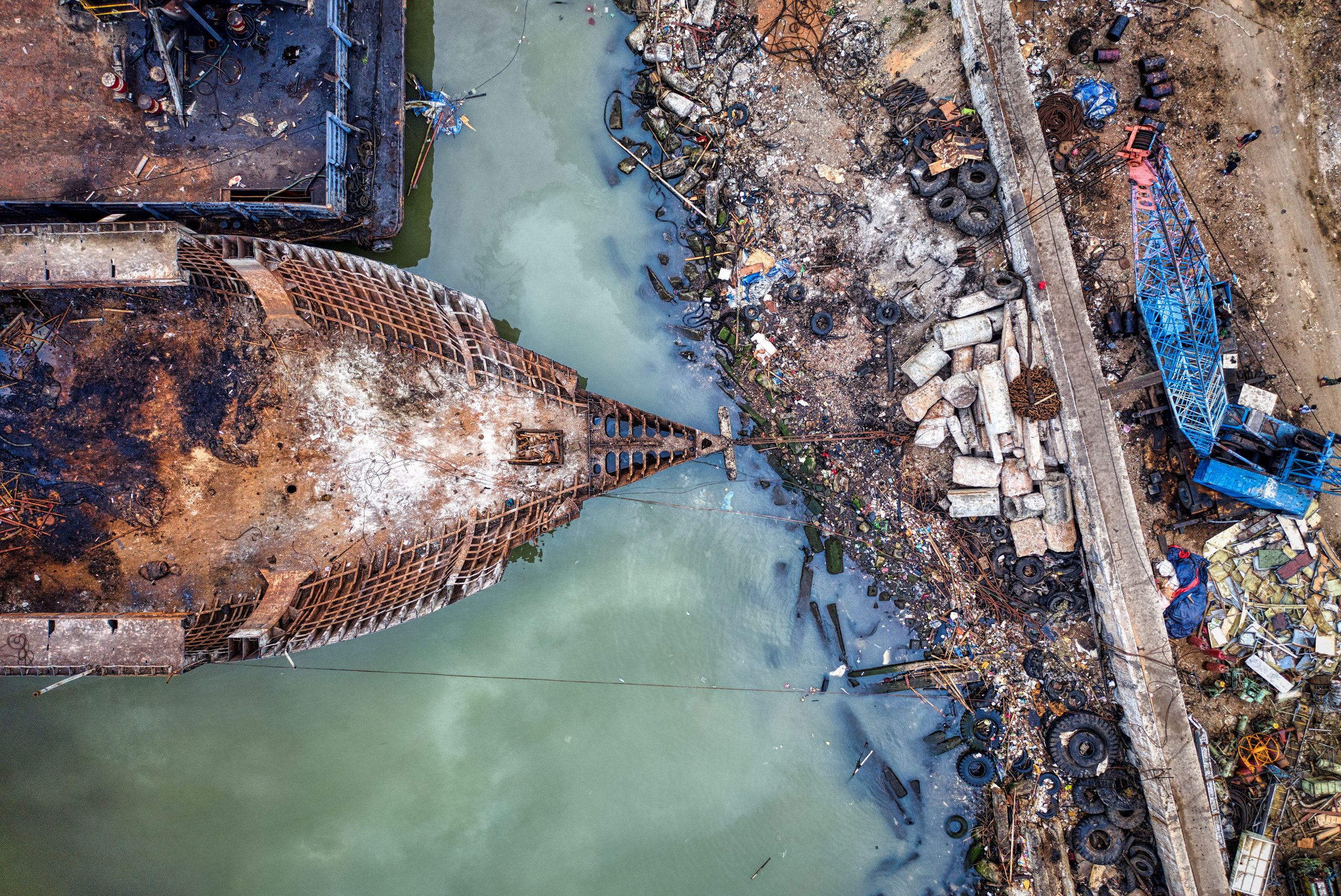
Most people do not think of waste as an internationally traded commodity. Yet waste, much like food, metals or manufactured products, routinely moves from one territory to another.
This trade is not new. During the 1970s and particularly the 1980s, transboundary movements of hazardous waste became increasingly visible. As environmental regulation and disposal costs increased in industrialized countries, some hazardous wastes were shipped to countries where treatment was cheaper and environmental and administrative controls were weaker or non-existent. Many receiving countries were newly established post WWII. They had limited institutional, technical and enforcement capacity to prevent their entry, or once imported they could not identify hazardous shipments, and assess their risks.
At the same time, the United Nations was increasingly becoming an arena not only for maintaining international peace and security, but also for coordinating responses to environmental and economic problems crossing national borders. International agreements increasingly became the preferred response to such problems.
It was in this context that the Basel Convention on the Control of Transboundary Movements of Hazardous Wastes and Their Disposal was adopted in 1989 and entered into force in 1992.
A ban that became a consent procedure
One of the central controversies during the Basel negotiations concerned the movement of hazardous waste from industrialized countries to developing countries. Strong demands existed, particularly among developing countries, for an outright prohibition on such movements. However, what emerged was a compromise on which negotiating nations could all agree on. The Convention established a Prior Informed Consent, or PIC, procedure. Controlled wastes can in principle move from one country to another provided the relevant notification procedures are followed and the importing country consents.
Instead of establishing the principle that countries should deal with the hazardous wastes they generate within their own territories, the Convention effectively accepted that an international market in waste could continue, provided certain procedures were followed.
The practical consequence is significant. Much of the burden of protection remains with the importing country. Its authorities must identify the waste correctly, understand its characteristics, evaluate the proposed recovery or disposal operation, coordinate among environmental and customs authorities and decide whether consent should be given. Only after all of that, to ensure its sound management, recovery, recycling or final disposal.
In 1945, the UN had only 51 founding members. By 1989, UN membership had increased by 108 states. Dozens of colonial territories were transformed into internationally recognized sovereign states. Many inherited territorial boundaries and administrative structures created under colonial rule rather than borders corresponding to earlier political entities. Formal sovereignty therefore did not necessarily mean institutional strength, economic autonomy or freedom from dependence on former colonial powers.
The Basel Convention in essence was a substantial burden for the countries with young administrative institutions, limited laboratory, technical, legal and human capacity, understaffed customs services or incomplete information about domestic waste-management facilities. Until 1989, a sovereign nation could have imposed a blanket ban on any sort of waste entering its territory. Yet, the Basel Convention instead institutionalized a system in which transboundary waste movements were treated as potentially legitimate provided certain classifications, procedures and conditions were met.
In practice, this shifted attention from the simpler question of whether foreign waste should be admitted at all to the much more demanding task of identifying which waste shipments fell within the Convention, which could legally be accepted, under what conditions consent could be given, and when authorities had sufficient grounds to refuse them. For states with limited administrative and technical capacity, the burden of navigating that system could itself weaken effective control.
More than three decades later, most parties to the Convention do not impose a total and complete ban on entry of waste of any sort into their territory, making waste shipment a normalcy similar to shipment of other commodities.
The question this article is therefore asking is whether this framework Convention provide an effective system for controlling actual movements of waste. The evidence gives considerable reason for doubt.
A legally binding convention that cannot reliably tell us what waste is moving
At the backdrop of the history of the Convention and its central objective, it should not come as a shock that reliable data and information on the movement of controlled waste, types of waste in particular hazardous waste, and the quantities traded is extremely complicated to establish using the Convention’s publicly available information.
Even though the Convention is legally binding, there is no enforcement function. First, there is reporting obligations under Article 13(3) to submit annual national reports (basel.int), yet the Secretariat has not power to oblige parties to actually do so.
Secondly, it has an Implementation and Compliance Committee which has no enforcement power. Enforcement remains overwhelmingly dependent on national authorities. The Convention cannot routinely inspect shipments, independently monitor borders or impose the sort of sanctions that would accompany a centralized regulatory system.
Coming back to national reporting which is supposed to contain information relevant to transboundary movements, including imports and exports of controlled waste, has been one of the Convention’s persistent weaknesses. The Basel Secretariat’s own guidance acknowledges that, despite the Article 13 obligation, reporting rates historically remained around 50 percent, and that only a small proportion of Parties submitted complete reports. For 2009–2013, reporting rates ranged between 40 and 53 percent. basel.int
The result is an unusual situation: the international treaty is legally binding, but the international system itself often lacks the information necessary to determine whether its most basic control procedures are working.
Case study: Islamic Republic of Iran explicitly left the door open to hazardous-waste imports for recovery
Iran has existed as the longest unified political entity with a long tradition of centralized governance, bureaucracy, taxation and trade for at least 2,500 years. Iran was moreover a founding Member State of the United Nations. It therefore does not fit the profile of states newly created through twentieth-century whose regulatory weakness can be explained by the absence of a long-standing state tradition. This makes Iran a particularly revealing case through which to assess the effectiveness of the Basel Convention.
However, The Islamic Republic of Iran acceded to the Convention on 5 January 1993. It is notable that Iran has not adopted a prohibition on imports of hazardous waste for recovery.
In its 2007 Basel reporting, Islamic Republic stated that imports of hazardous and other wastes for recovery could take place because the country had the capability to recover some imported hazardous wastes, including used lead-acid batteries among others, in an environmentally sound manner. basel.int
Used lead-acid batteries are particularly relevant. They are clearly hazardous waste under the Basel Convention: used lead-acid batteries are classified as A1160, associated with lead and acidic solutions, and are commonly sent for metal recovery under operation R4.
The question then becomes: what has actually been entering Iran?
Basel reporting should be able to answer that question in principle, however, the Islamic Republic’s record of national reporting is highly discontinuous. According to the international environmental-law database InforMEA, Iran submitted Basel national reports for: 2001, 2002, 2006, 2007, 2008, 2009, 2010, 2012, 2013, 2014 and 2015.
No report is listed for 2003, 2004, 2005, 2011 and the years after 2015. More strikingly, Iran’s last listed report is for 2015. The 2015 report itself was not submitted until 26 April 2019, almost four years after the reporting year. The Basel Convention’s own annual reporting pages state that only countries that submitted reports are listed. Iran is absent from the reporting records for the subsequent years examined.
So a country that has remained a Party to the Convention, hosts a Basel Convention Regional Centre in Tehran, and continues to participate in international waste movements has no publicly listed annual national report after 2015 in the consolidated reporting record we examined. And its existing reports does not provide a comprehensive view of the waste shipments, including hazardous waste entry into the country.
What customs data reveal
To answer the question ‘what has actually been entering Iran‘, a second source becomes critical: UN Comtrade, including data accessed through the World Bank’s WITS trade database.
Comtrade is not an environmental compliance database. It does not tell us whether a shipment complied with Basel, whether PIC consent was obtained or whether the receiving facility managed the waste in an environmentally sound manner.
Yet, customs data can tell us that material classified as waste physically crossed an international border.
And for Iran, they reveal substantial movements that are essentially invisible if one relies only on recent Basel national reporting.
Used lead-acid batteries
The evidence concerning used lead-acid batteries being imported into Iran is significant because these are unambiguously hazardous waste.
A regional hazardous-waste assessment of Armenia reports that collected used lead-acid batteries were exported to Iran and provides the following quantities:
2017: 7,022 tonnes
2018: 6,365 tonnes
2019: 4,691 tonnes
2020: 3,700 tonnes
The report identifies Armenian companies licensed to collect, store and export these wastes and states that the collected lead batteries were exported to Iran. That amounts to approximately 21,800 tonnes in only four years.
There is also evidence from Kyrgyzstan of proposed exports of used lead-acid batteries to Iran through Uzbekistan and Turkmenistan.
Taken together, these flows indicate that Iran operates as a regional destination for hazardous secondary materials, particularly lead-bearing waste.
Plastic waste
In 2023, Iran reported importing approximately 2,187 tonnes of waste, parings and scrap of plastics under HS 3915. Of this:
- 1,918 tonnes came from Iraq;
- 100 tonnes from Pakistan;
- approximately 97 tonnes from Italy;
- approximately 41 tonnes from the United Arab Emirates;
- approximately 31 tonnes from Germany.
The data are available in the World Bank WITS/UN Comtrade record for Iranian plastic-waste imports. Iraq alone supplied approximately 88 percent of Iran’s reported plastic-waste imports in that single year. This was not an isolated shipment. Earlier Iranian trade data also show sustained imports of plastic waste from Iraq and other countries.
At the same time, Iran exports plastic waste. Partner-country customs statistics show that Azerbaijan alone reported importing more than 21,000 tonnes of plastic waste from Iran in 2023, alongside imports by Hong Kong, Uzbekistan, Türkiye and Iraq. The corresponding mirror statistics can be seen here.
HS 3915 is much broader than any one Basel plastic-waste category. It simply means “waste, parings and scrap, of plastics” in customs classification. Under HS 2017 it breaks down as: 391510 ethylene polymers, 391520 styrene polymers, 391530 vinyl chloride polymers, and 391590 other plastics. UNSD
Under the Basel plastic-waste amendments, effective from 1 January 2021, that same customs material can fall into three different Basel categories depending on composition, contamination, hazardous characteristics and intended recycling:
- A3210 — hazardous plastic waste. It is presumed hazardous and is subject to PIC.
- Y48 — plastic waste, including mixtures, that is neither A3210 nor B3011. This is also subject to PIC.
- B3011 — specified non-hazardous plastic waste that is generally not subject to PIC, provided it meets strict conditions: for example certain single non-halogenated polymers/resins, selected fluorinated polymers, or certain PE/PP/PET mixtures destined for separate environmentally sound recycling, and almost free from contamination and other wastes.
Thus, HS 3915 data tell us that plastic waste crossed the border, but they do not tell us whether that waste was A3210, Y48 or B3011 under the Basel Convention. That in itself does not indicate that Islamic Republic is in breach of the provisions of the Convention.
Then, what does Basel tell us about these movements?
This is where the central problem appears. Iran’s Basel national reporting essentially stops before some of the most recent waste movements identified through customs and other sources. The Armenian battery movements described above continued from 2017 onward. Iran’s plastic-waste imports are documented in 2023.
Yet, Iran has no listed Basel national reports after 2015 in the reporting record examined. The Convention’s reporting system therefore does not enable a researcher to determine from Iran’s national reports whether these shipments were notified, consented to, classified under the appropriate Basel entries, sent to authorized recovery installations or ultimately processed as intended.
We know the trade took place because other systems recorded it. UN Comtrade exists primarily to record merchandise trade. It was never designed to monitor implementation of the Basel Convention. Nevertheless, it can reveal international movements of identifiable waste during years for which the Convention’s own reporting system provides little or no information.
This is an evidence of an ineffective monitoring architecture.
Trade data cannot prove compliance — but missing Basel data cannot prove it either
This exposes a deeper weakness in the Basel model.
The Convention was developed partly in response to an international waste trade in which weaker states could be placed at a disadvantage by richer waste-generating economies and international traders. Yet the solution adopted — PIC — depends heavily on those same importing states possessing strong institutions.
They need competent environmental authorities, trained customs officials, functioning waste inventories, technical capacity to classify difficult waste streams, effective exchange of information between ministries and the ability to inspect and enforce conditions after the shipment arrives.
In other words, the Convention places enormous responsibility on national systems while possessing limited ability to act when those systems fail.
More than thirty six years later, is Basel effective?
On the evidence examined here, there is a strong basis for questioning whether the Basel Convention is effective as a mechanism for controlling and transparently monitoring international waste movements.
Effectiveness must ultimately be judged by outcomes, not by the existence of rules.
The inability of the Basel reporting and compliance architecture to provide a continuous, transparent account of them demonstrates something else: the Convention cannot reliably show that the system it established is actually controlling them.
That is a serious measure of ineffectiveness.
The Basel Convention may influence national legislation and individual waste transactions. However, if its own international machinery cannot reliably answer the basic questions — what waste moved, where did it go, was consent obtained, and what happened to it afterwards? — then its effectiveness as a global control mechanism must be questioned much more fundamentally. The final question is if tomorrow Basel Convention does not exist, will the world see a real change in the transboundary movement of waste.
Have you read our previous insight?