
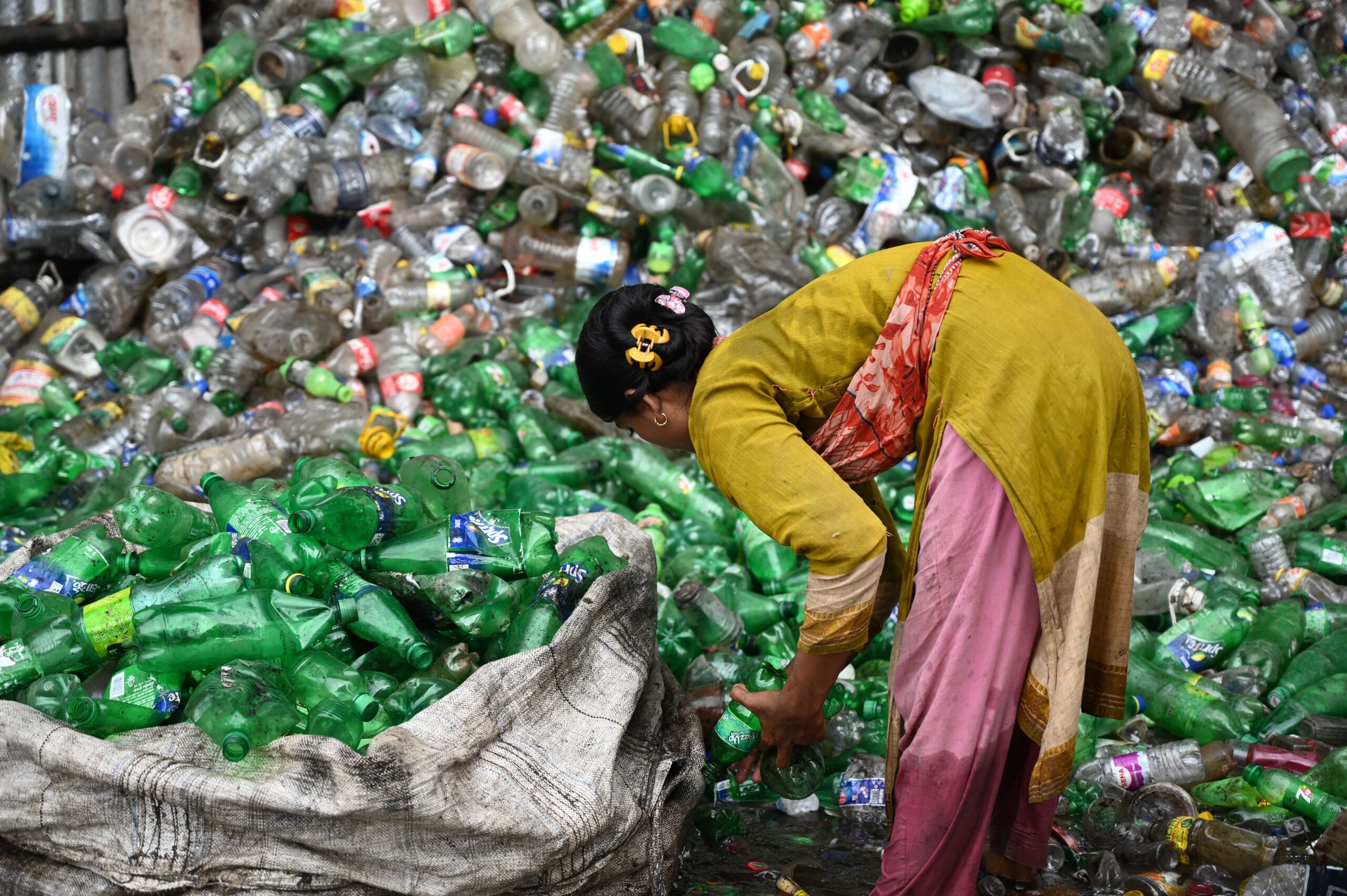
Artificial intelligence is already being used in recycling facilities, especially in material recovery facilities where mixed waste streams need to be sorted quickly and accurately. The clearest applications of AI are not abstract policy dashboards, but practical systems that use computer vision, optical sorting, robotics, and deep learning to identify materials, reduce contamination, and improve recovery. Can AI revolutionise how we sort and recycle plastic waste?
While the examples below are mainly from the United States and China, the technology has significant potential for improving plastic waste recycling worldwide. One of the major challenges in the sector remains sorting, which in many places still depends heavily on manual labour. Manual sorting can be costly, inconsistent, unsafe, and difficult to scale, especially when waste streams are contaminated or poorly separated.
If waste management is to function as a viable economic sector, not only as a public-service obligation, investment in technologies with a clear return on investment becomes essential. The private sector is more likely to invest when there is a sustainable business model linking collection, sorting, material recovery, and the manufacturing of new products from plastic waste. AI and automated sorting technologies are therefore not only technical upgrades. They can become part of a broader economic model that makes plastic waste recovery more efficient, predictable, and commercially viable.
Murphy Road Recycling: Facility-Wide AI Monitoring
Murphy Road Recycling’s All American MRF in Berlin, Connecticut, is one example of AI being used across a recycling facility.
The facility has deployed Greyparrot AI analyzers across its sorting lines. Greyparrot reported that Murphy Road’s All American MRF was the first facility in the United States to deploy facility-wide AI monitoring, with 15 Analyzer units installed across the plant. These systems use computer vision to monitor material streams and provide data on what is moving through the facility, including contamination, material composition, capture rates, and potential material losses.
Murphy Road has also expanded the MRF with additional optical sorters, showing how AI monitoring can be combined with more traditional automated sorting equipment.
WM South Florida MRF: AI and Optical Sorting at Large Scale
WM’s recycling facility in Pembroke Pines, Florida, is another example of automation being used at industrial scale.
The facility is a 127,000-square-foot material recovery facility with 18 MSS optical sorters. One of these optical sorters is equipped with AI technology for the recovery of used beverage cans. The system is part of a larger automated sorting process that separates material after mechanical and manual sorting stages.
The facility is reported to cost around $90 million and is expected to process about 275,000 tons of recyclables per year, making it one of WM’s major recycling infrastructure investments in the United States.
TOMRA GAINnext: Deep Learning for High-Speed Sorting
TOMRA’s GAINnext system is a clear example of AI being built directly into industrial sorting equipment.
GAINnext uses AI-based visual classification and deep-learning technology to identify objects in waste streams. TOMRA says the system can identify thousands of objects in milliseconds and support high-throughput sorting, with up to 2,000 ejections per minute depending on the application.
TOMRA has described GAINnext as a deep-learning solution for high-accuracy sorting of multiple material streams. The system is designed to improve recovery and purity levels for valuable recyclable materials, including applications where conventional sensor-based sorting may struggle with complex or overlapping objects.
What These Examples Have in Common
These examples show three practical uses of AI and automation in recycling facilities:
AI monitoring systems, such as Greyparrot, help operators understand what is happening on sorting lines in real time.
AI-enabled optical sorting, such as the system used at WM’s South Florida MRF, helps recover targeted materials at high speed.
Deep-learning sorting platforms, such as TOMRA GAINnext, help identify and separate difficult materials more accurately.
Together, these examples show that AI in recycling is already moving beyond experimentation. It is being used inside real facilities to improve material recovery, increase sorting accuracy, reduce contamination, and support more efficient recycling operations.
Read our article on Plastic Waste: Why Treaties Are Not Enough