
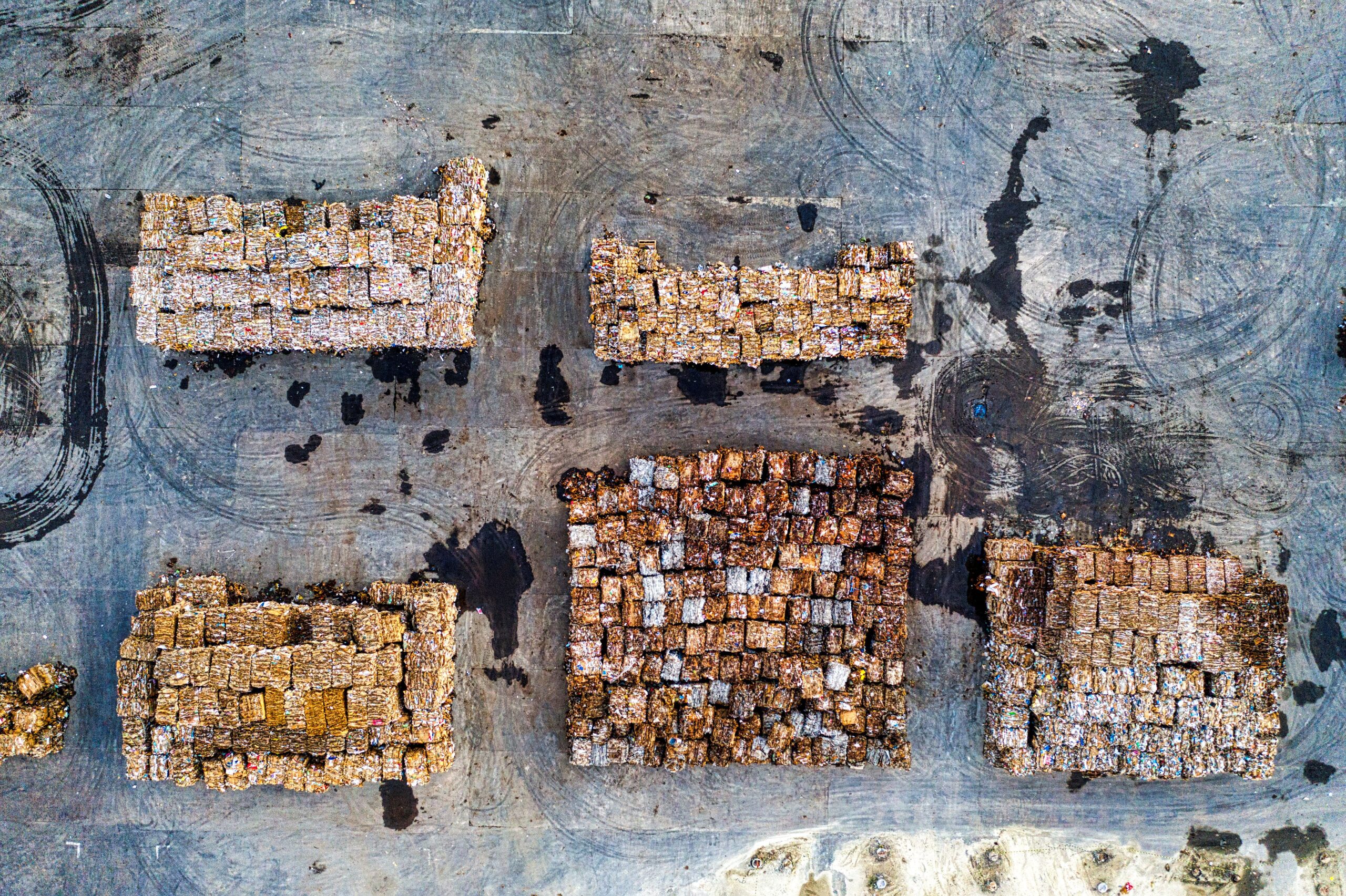
Plastic waste is often discussed as a production problem. That is partly true. Plastic production continues to grow, and without stronger action, plastic waste will continue to increase.
But in many parts of the world, the more immediate crisis is not only how much plastic is produced. It is that waste-management systems are absent or incomplete.
Many countries have waste collection in capital cities and large urban centres, but not across their entire geography. Rural areas, informal settlements, islands, mountain communities, peri-urban zones and remote municipalities are often left outside reliable collection systems. As a result, plastic waste does not enter a formal recovery chain at all. It is dumped, burned, buried, washed into waterways, or handled through informal systems.
The World Bank has reported that around 23% of global waste goes uncollected, while 33% is openly dumped. In low-income countries, the situation is far more severe: around 60% of solid waste goes uncollected, and 93% is improperly managed. Earlier World Bank analysis also found that low-income countries collect about 48% of waste in cities, but only 26% in rural areas.
The UNEP Global Waste Management Outlook 2024 estimated that municipal solid waste generation could rise from 2.1 billion tonnes in 2023 to 3.8 billion tonnes by 2050. It also estimated the direct global cost of waste management at USD 252 billion in 2020, rising to USD 361 billion when hidden costs such as pollution, health damage and climate impacts are included.
These figures show why the plastic waste debate becomes too abstract when it focuses only on treaties, targets and circular economy language. The operational question remains unresolved: who collects the plastic waste, from where, at what cost, how often, through which route, under which responsibility, and with what measurable result?
The Missing Layer Between Policy and Implementation
Most countries do not lack policies. They have plastic waste management strategies, waste laws, recycling targets, bans on certain plastic products, national action plans and extended producer responsibility schemes.
What is often missing is the operational layer that turns policy into daily service delivery.
A law may say that plastic waste should be collected and recycled. But this does not automatically create waste collection and processing systems. Plastic waste is a waste stream and as such should be looked at within the larger waste management frameworks. If household and urban waste is not collected and disposed of, so is plastic waste.
This is where digital operational tools become important. They can help governments and municipalities move from general policy commitments to practical implementation.
What Digital Tools Should Actually Target
The purpose of digital tools in waste management is to solve specific operational problems.
A useful system should help authorities see where waste collection exists, where it is irregular, and where it is completely absent. It should connect this coverage map to collection routes, vehicle capacity, road access, transfer stations, recycling facilities, disposal sites and service frequency.
In practical terms, this means answering basic but often unanswered questions: Which communities are covered? Which collection points are active? Which areas are repeatedly missed? Which routes are inefficient? Which contractor is responsible? What is the real cost per household, per kilometre, or per tonne collected? Where is waste leaking from the system?
Digital tools can also help manage the actors involved in waste operations. Waste management depends on national authorities, municipalities, private operators, recyclers, producer responsibility organisations, informal collectors, tourism businesses and enforcement agencies. If these actors are not digitally connected, responsibilities remain fragmented and implementation becomes difficult to monitor.
Another major target is collection-point management. A collection point is not just a location where waste is left. It is infrastructure. It has a capacity, material type, service frequency, responsible operator, overflow risk and maintenance need. When collection points are mapped, photographed, assigned and monitored digitally, they become part of a managed system rather than an informal dumping area.
Digital systems can also support enforcement. Plastic bans, dumping rules, contractor obligations and waste shipment controls are often difficult to enforce because evidence is scattered. Geotagged reports, inspection records, repeat dumping hotspots, contractor performance data and follow-up actions can help authorities move from weak enforcement to evidence-based enforcement.
Finally, digital tools can improve reporting. Too many waste projects produce reports after the fact, without giving governments a real view of what is happening during implementation. Reporting should be connected to the operation itself: routes, actors, costs, collection points, complaints, inspections, material flows and recycling outputs.
Plastic Waste Must Be Managed as a Material Flow
Plastic waste is often counted too late, after it reaches a recycler, landfill or export point. By then, much of it may already have leaked out of the system.
A more effective approach is to track plastic waste as a material flow: where it is generated, where it is collected, where it is aggregated, where it is sorted, where it is recycled, and where it is lost.
This matters especially for countries that have partial waste-management systems. A capital city may have collection, but rural areas may not. A tourist area may have bins, but no reliable transport. A plastic ban may exist, but no one may be monitoring whether banned products are still being used. A recycling target may be announced, but there may be no data showing whether material is actually recovered.
Without operational data, plastic waste management remains a policy aspiration. With operational data, it becomes a system that can be measured, improved and financed.
From Waste Policy to Operational Control
The plastic waste crisis is not only about production. It is also about the failure to build systems that collect, move, sort, finance, monitor and enforce waste management across entire countries.
Many countries have partial systems. They may cover large cities, central districts or commercially valuable waste streams. But a functional national waste-management system requires more than visible service in the capital. It requires operational coverage across geography.
Fussbann Group develops digital solutions that help governments, municipalities, international organisations and private actors operationalise waste-management policies. Our focus is the practical layer where implementation succeeds or fails: coverage, routes, actors, costs, collection points, enforcement, reporting and measurable results.
Plastic waste cannot be managed only through declarations, targets or treaty language. It must be managed through systems that show what is happening on the ground and help institutions act on that information.
Read our article on Can AI Improve Plastic Waste Management